
Welding Technology Diploma (D50420P)
This curriculum is available to eligible High School students through the Career and College Promise Program.
Semesters
Saved courses will be emailed to you. Click the ribbon after each title to select.

First Fall Semester
Writing and Inquiry
This course is designed to develop the ability to produce clear writing in a variety of genres and formats using a recursive process. Emphasis includes inquire, analysis, effective use of rhetorical strategies, thesis development, audience awareness, and revision. Upon completion, students should be able to produce unified, coherent, well-developed essays using standard written English. This course has been approved for transfer under the CAA and ICAA as a pre-major and/or general education elective course requirement for the AA, AS or AE degrees. This is a Universal General Education Transfer Component (UGETC) course in English Composition for the AA, AE, and AS degrees.
Cutting Processes
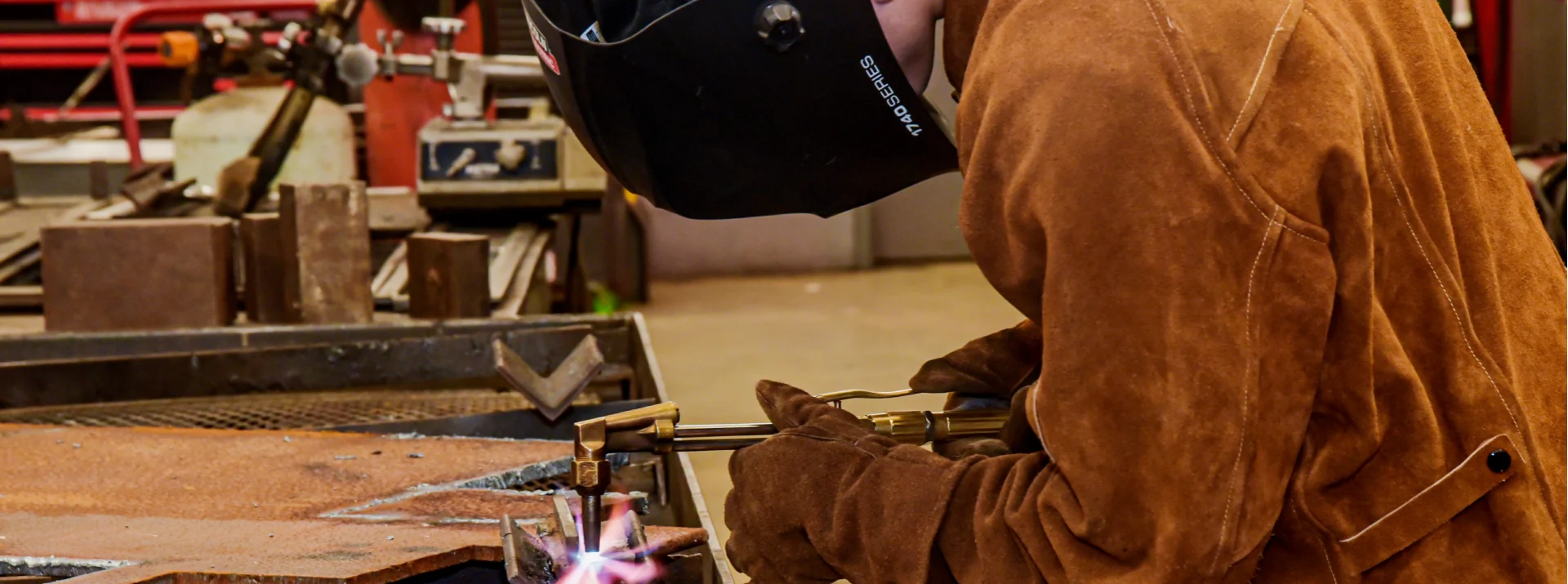
This course introduces oxy-fuel and plasma-arc cutting systems. Topics include safety, proper equipment setup, and operation of oxy-fuel and plasma-arc cutting equipment with emphasis on straight line, curve and bevel cutting. Upon completion, students should be able to oxy-fuel and plasma-arc cut metals of varying thickness.
SMAW (Stick) Plate/Pipe
This course introduces the shielded metal arc (stick) welding process. Emphasis is placed on padding, fillet, and groove welds in various positions with SMAW electrodes. Upon completion, students should be able to perform SMAW fillet and groove welds on carbon plate with prescribed electrodes. Credit for W LD 115 is only available after completion of both WLD 115AB and WLD 115BB.
GTAW (TIG) Plate
This course introduces the gas tungsten arc (TIG) welding process. Topics include correct selection of tungsten, polarity, gas, and proper filler rod with emphasis placed on safety, equipment setup, and welding techniques. Upon completion, students should be able to perform GTAW fillet and groove welds with various electrodes and filler materials.
Industrial SMAW
This course introduces the SMAW (stick) process for joining carbon steel components for industrial applications. Topics include padding, fillet, and groove welds in various positions with SMAW electrodes. Upon completion, student should be able to safely perform SMAW fillet and groove welds on carbon steel plate with prescribed electrodes.
Semester Total
15
First Spring Semester
SMAW (Stick) Plate
This course introduces the shielded metal arc (stick) welding process. Emphasis is placed on padding, fillet, and groove welds in various positions with SMAW electrodes. Upon completion, students should be able to perform SMAW fillet and groove welds on carbon plate with prescribed electrodes. Credit for W LD 115 is only available after completion of both WLD 115AB and WLD 115BB.
GMAW (MIG) FCAW/Plate
This course introduces metal arc welding and flux core arc welding processes. Topics include equipment setup and fillet and groove welds with emphasis on application of GMAW and FCAW electrodes on carbon steel plate. Upon completion, students should be able to perform fillet welds on carbon steel with prescribed electrodes in the flat, horizontal, and overhead positions.
Symbols & Specifications
This course introduces the basic symbols and specifications used in welding. Emphasis is placed on interpretation of lines, notes, welding symbols, and specifications. Upon completion, students should be able to read and interpret symbols and specifications commonly used in welding.
GTAW (TIG) Plate/PIPE
This course is designed to enhance skills with the gas tungsten arc (TIG) welding process. Topics include setup, joint preparation, and electrode selection with emphasis on manipulative skills in all welding positions on plate and pipe. Upon completion, students should be able to perform GTAW welds with prescribed electrodes and filler materials on various joint geometry.
Semester Total
12
First Summer Semester
GTAW (TIG) Pipe
This course introduces the gas tungsten arc (TIG) welding process. Topics include correct selection of tungsten, polarity, gas, and proper filler rod with emphasis placed on safety, equipment setup, and welding techniques. Upon completion, students should be able to perform GTAW fillet and groove welds with various electrodes and filler materials.
Inspection & Testing
This course introduces destructive and non- destructive testing methods. Emphasis is placed on safety, types and methods of testing, and the use of testing equipment and materials. Upon completion, students should be able to understand and/or perform a variety of destructive and non- destructive testing processes.
Math Measurement & Literacy
This course is designed to provide communication skills, basic education principles, and knowledge of available community resources and to apply this knowledge to the clinical setting. Emphasis is placed on identifying appropriate community resources, developing patient education materials, and perfecting written and oral communication skills. Upon completion, students should be able to instruct, communicate effectively, and act as a liaison between the patient and community agencies.
Semester Total
9
Total Program Credit
36
Start your Path
Bring your goal to life


STUDENT STORY
Caroline Bailey
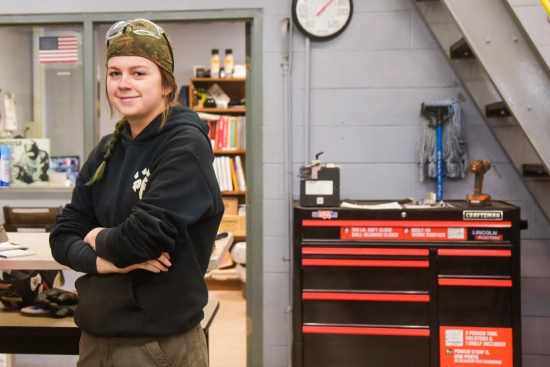
Congratulations to Caroline Bailey for being named as a BCC Student of the Month. “In every way, Caroline represents the best of BCC,” said Instructor Heather Hardie. “She’s a team player, hard worker, and has a heart of gold. Her passion for learning and helping others inspires us all.”