
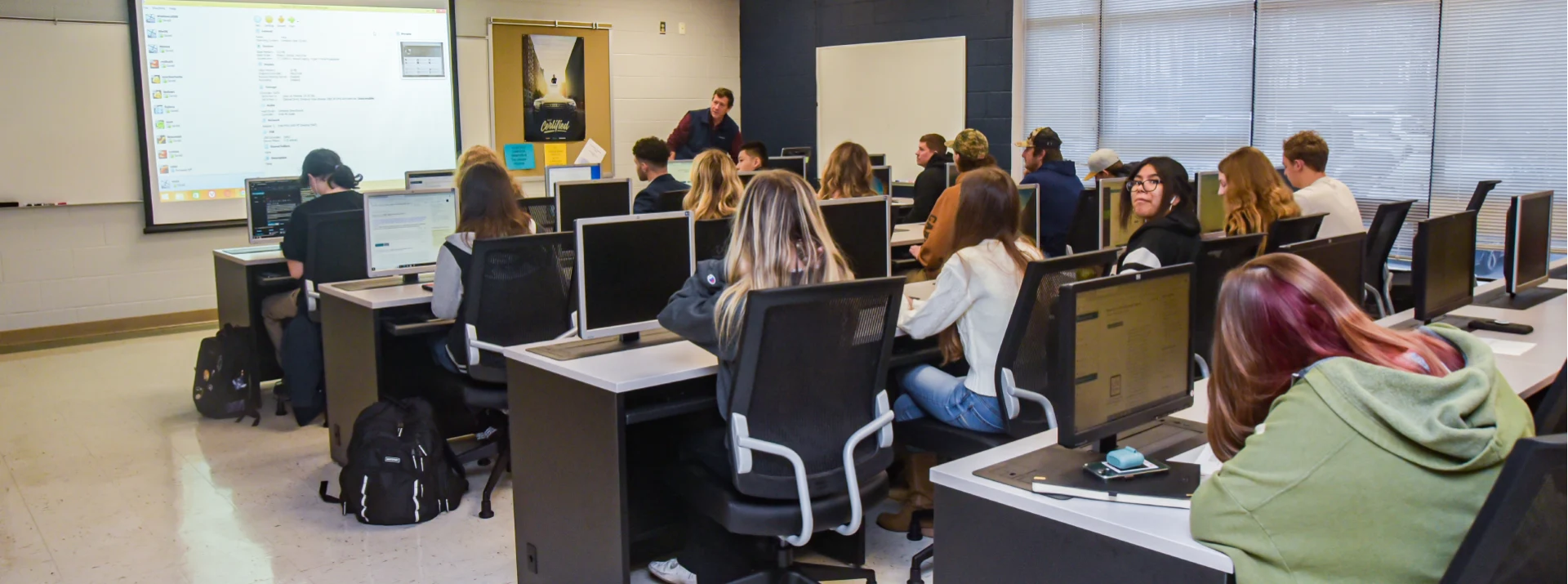
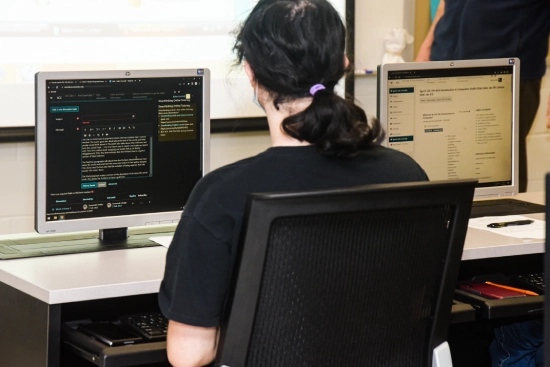

Information Technology Diploma Image
small-image

Python Programming (C25590PY)

The Information Technology (IT) curriculum prepares graduates for employment in the technology sector as designers, testers, support technicians, system administrators developers, or programmers who use computer software and/or hardware to design, process, implement and manage information systems in specialties such as database services, security, business intelligence, healthcare informatics and others depending on the technical path selected within this curriculum.

Semesters

Saved courses will be emailed to you. Click the ribbon after each title to select.

Class room image
First Fall Semester

IT Foundations

This course covers the introduction of the tools and resources available to students in programming, mark-up language and services on the Internet. Topics include standard mark-up language Internet services, creating web pages, using search engines, file transfer programs; and database design and creation with DBMS products. Upon completion students, should be able to demonstrate knowledge of programming tools, deploy a web-site with mark-up tools, and create a simple database table.

CTI 110

Length: 2
Credits: 3
Lecture: 2
Lab: 2

Introduction to Computers

This course introduces computer concepts, including fundamental functions and operations of the computer. Topics include identification of hardware components, basic computer operations, security issues, and use of software applications. Upon completion, students should be able to demonstrate an understanding of the role and function of computers and use the computer to solve problems. This course has been approved for transfer under the CAA and ICAA as a general education course in Mathematics (Quantitative Option) in the AA & AS degrees.

CIS 110

Length: 2
Credits: 3
Lecture: 2
Lab: 2

Python Programming

This course introduces computer programming using the Python programming language. Emphasis is placed on common algorithms and programming principles utilizing the standard library distributed with Python. Upon completion, students should be able to design, code, test, and debug Python language programs.

CSC 121

Credits: 3
Lab: 2

Advanced Python Programming

This course introduces the challenges of entrepreneurship including the startup and operation of a small business. Topics include market research techniques, feasibility studies, site analysis, financing alternatives, and managerial decision making. Upon completion, students should be able to develop a small business plan.

CSC 221

Prerequisites:

ACC 120

This course introduces business decision-making using accounting information systems. Emphasis is placed on analyzing, summarizing, reporting, and interpreting financial information. Upon completion, students should be able to prepare financial statements, understand the role of financial information in decision- making and address ethical considerations.  This course has been approved for transfer under the CAA and ICAA as a pre-major and/or elective course requirement for the AA & AS degrees.

Length: 3
Credits: 3
Lecture: 3

Introduction to Programming and Logic

This course introduces computer programming and problem solving in a structured program logic environment. Topics include language syntax, data types, program organization, problem solving methods, algorithm design, and logic control structures. Upon completion, students should be able to manage files with operating system commands, use top-down algorithm design, and implement algorithmic solutions in a programming language. This course has been approved for transfer under the CAA and ICAA as a general education course in Mathematics (Quantitative Option) in the AA & AS degrees.

CIS 115

Prerequisites:

ENG 025

This course provides the skills necessary for success in college English courses. Topics include reading and writing processes and strategies, such as critical thinking, text analysis, idea development, and application of writing conventions. Upon completion, students should be able to analyze readings and produce unified, coherent, well developed paragraphs and essays using appropriate document design and standard written English while developing positive academic habits, learning strategies, and a growth mindset.

and

MAT 025

This course provides an opportunity to customize foundational math content and statistical concepts specific to real-world applications. Topics include decimals, percentages, ratios, proportions, solving basic equations, geometrical concepts, dimensional analysis, financial applications and elements of statistics and probability. Upon completion, students should be able to successfully demonstrate the use of mathematics, technology and statistical concepts to solve practical problems while developing positive academic habits, learning strategies and growth mindset.

or

MAT 035

This course covers algebraic concepts with an emphasis on application and analysis. Topics include rational/radical expressions and equations, solving equations and inequalities, concepts of functions, factoring, and exponents. Upon completion, students should be able to successfully demonstrate mastery of algebraic concepts through application and analysis while developing positive academic habits, learning strategies and growth mindset.

Length: 2
Credits: 3
Lecture: 2
Lab: 3
Semester Total 15
Total Program Credit 15
BrunswickComCol_WebsiteAsset_FlowerLady_HeadRoom
BrunswickComCol_WebsiteAsset_Mobile_Trophy_HeadRoom

STUDENT STORY

Caroline Bailey

Congratulations to Caroline Bailey for being named as a BCC Student of the Month. “In every way, Caroline represents the best of BCC,” said Instructor Heather Hardie. “She’s a team player, hard worker, and has a heart of gold. Her passion for learning and helping others inspires us all.”

Find your path

Need Help Choosing?

Not sure which program is right for you? Our Success Coaches are here to help.

OneStop Student Services, Building A, Brunswick Community College

(910) 755-7320 | onestop@brunswickcc.edu

Close

TELL US ABOUT YOURSELF.

WHAT INTERESTS YOU? (CHOOSE UP TO 3)

WHAT CREDENTIAL ARE YOU HOPING TO EARN?

In about two years, you can earn an Associate of Arts, Associate of Science, or an Associate of Applied Science degree. Many students continue their education at a four-year college or university.
A diploma takes less time (9-18 months) than a degree and provides you with hands-on training and skills in a specific field. You are workforce ready.
If you want focused training in a specific skill or industry in less than one year, a certificate program may be for you.
In less than six months, you train for employment in a specific field or career type, short-term industry training programs are a great place to start. Some programs offer industry recognized credentials.
High School students can accelerate the completion of college certificates, diplomas, and associate degrees.
Complete a high school credential (GED®) that mirrors a public-school credential.
Prepares adults to take the High School Equivalency Test.

HOW WOULD YOU PREFER TO LEARN?

WHEN WOULD YOU LIKE TO COMPLETE YOUR PROGRAM?

BASED ON YOUR RESPONSES, THESE PROGRAMS MAY BE A GREAT FIT FOR YOU.

Every student's path is different. Explore these recommended programs to learn more about the opportunities available at Brunswick Community College.

Find your pathways and take the next step forward

Wherever you’re starting, we’re here to help you take the next step.

Pathways Wizard is your personal academic navigator—helping you map out the right path to reach your goals and turn confusion into a clear plan forward.