
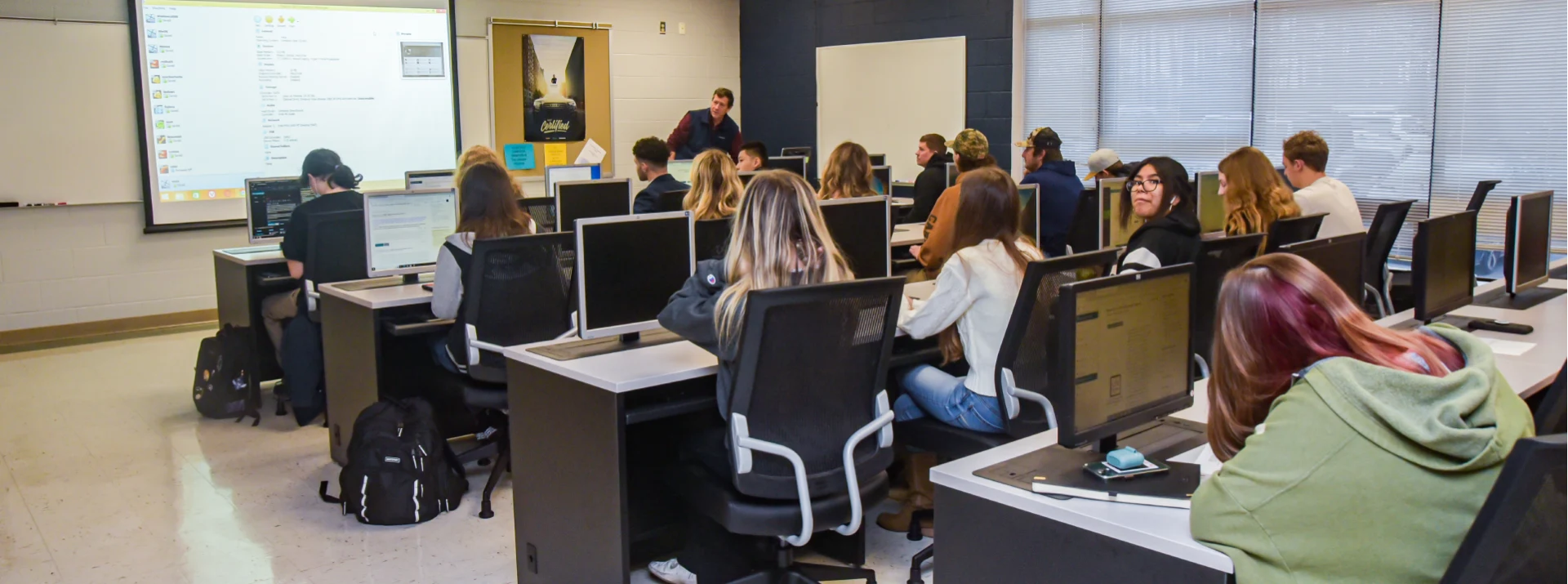


Information Technology Diploma Image
small-image

Information Technology – Software & Web Development (D25590WP)

The Information Technology (IT) curriculum prepares graduates for employment in the technology sector as designers, testers, support technicians, system administrators developers, or programmers who use computer software and/or hardware to design, process, implement and manage information systems in specialties such as database services, security, business intelligence, healthcare informatics and others depending on the technical path selected within this curriculum.

Semesters

Saved courses will be emailed to you. Click the ribbon after each title to select.

Class room image
First Fall Semester

Introduction to Computers

This course introduces computer concepts, including fundamental functions and operations of the computer. Topics include identification of hardware components, basic computer operations, security issues, and use of software applications. Upon completion, students should be able to demonstrate an understanding of the role and function of computers and use the computer to solve problems. This course has been approved for transfer under the CAA and ICAA as a general education course in Mathematics (Quantitative Option) in the AA & AS degrees.

CIS 110

Length: 2
Credits: 3
Lecture: 2
Lab: 2

IT Foundations

This course covers the introduction of the tools and resources available to students in programming, mark-up language and services on the Internet. Topics include standard mark-up language Internet services, creating web pages, using search engines, file transfer programs; and database design and creation with DBMS products. Upon completion students, should be able to demonstrate knowledge of programming tools, deploy a web-site with mark-up tools, and create a simple database table.

CTI 110

Length: 2
Credits: 3
Lecture: 2
Lab: 2

Info Sys Business Concepts

The course introduces the role of IT in managing business processes and the need for business process and IT alignment. Emphasis is placed on industry need for understanding business challenges and developing/managing information systems to contribute to the decision-making process based on these challenges. Upon completion, students should be able to demonstrate knowledge of the ‘hybrid business manager’ and the potential offered by new technology and systems.

CTS 115

Length: 3
Credits: 3
Lecture: 3

Network & Security Foundation

This course introduces students to the Network concepts, including networking terminology and protocols, local and wide area networks, and network standards. Emphasis is placed on securing information systems and the various implementation policies. Upon completion, students should be able to perform basic tasks related to networking mathematics, terminology, media and protocols.

CTI 120

Length: 2
Credits: 3
Lecture: 2
Lab: 2

Introduction to Programming and Logic

This course introduces computer programming and problem solving in a structured program logic environment. Topics include language syntax, data types, program organization, problem solving methods, algorithm design, and logic control structures. Upon completion, students should be able to manage files with operating system commands, use top-down algorithm design, and implement algorithmic solutions in a programming language. This course has been approved for transfer under the CAA and ICAA as a general education course in Mathematics (Quantitative Option) in the AA & AS degrees.

CIS 115

Prerequisites:

ENG 025

This course provides the skills necessary for success in college English courses. Topics include reading and writing processes and strategies, such as critical thinking, text analysis, idea development, and application of writing conventions. Upon completion, students should be able to analyze readings and produce unified, coherent, well developed paragraphs and essays using appropriate document design and standard written English while developing positive academic habits, learning strategies, and a growth mindset.

and

MAT 025

This course provides an opportunity to customize foundational math content and statistical concepts specific to real-world applications. Topics include decimals, percentages, ratios, proportions, solving basic equations, geometrical concepts, dimensional analysis, financial applications and elements of statistics and probability. Upon completion, students should be able to successfully demonstrate the use of mathematics, technology and statistical concepts to solve practical problems while developing positive academic habits, learning strategies and growth mindset.

or

MAT 035

This course covers algebraic concepts with an emphasis on application and analysis. Topics include rational/radical expressions and equations, solving equations and inequalities, concepts of functions, factoring, and exponents. Upon completion, students should be able to successfully demonstrate mastery of algebraic concepts through application and analysis while developing positive academic habits, learning strategies and growth mindset.

Length: 2
Credits: 3
Lecture: 2
Lab: 3

Quantitative Literacy

This course is designed to engage students in complex and realistic situations involving the mathematical phenomena of quantity, change and relationship, and uncertainty through project- and activity-based assessment. Emphasis is placed on authentic contexts which will introduce the concepts of numeracy, proportional reasoning, dimensional analysis, rates of growth, personal finance, consumer statistics, practical probabilities, and mathematics for citizenship. Upon completion, students should be able to utilize quantitative information as consumers and to make personal, professional, and civic decisions by decoding, interpreting, using, and communicating quantitative information found in modern media and encountered in everyday life. This course has been approved for transfer under the CAA and ICAA as a general education course in Mathematics (Quantitative) for the AA & AS degrees. This is a Universal General Education Transfer Component (UGETC) course in Mathematics (Quantitative) for the AA degree ONLY.

MAT 143

Prerequisites:

MAT 035

This course covers algebraic concepts with an emphasis on application and analysis. Topics include rational/radical expressions and equations, solving equations and inequalities, concepts of functions, factoring, and exponents. Upon completion, students should be able to successfully demonstrate mastery of algebraic concepts through application and analysis while developing positive academic habits, learning strategies and growth mindset.

Length: 2
Credits: 3
Lecture: 2
Lab: 2
Semester Total 18
First Spring Semester

Web Markup & Scripting

This course introduces Worldwide Web Consortium (W3C) standard client-side Internet programming using industry-established practices. Topics include JavaScript, markup elements, stylesheets, validation, accessibility, standards, and browsers. Upon completion, students should be able to develop hand-coded web pages using current markup standards.

WEB 115

Credits: 3
Lecture: 2
Lab: 2

Writing and Inquiry

This course is designed to develop the ability to produce clear writing in a variety of genres and formats using a recursive process. Emphasis includes inquire, analysis, effective use of rhetorical strategies, thesis development, audience awareness, and revision. Upon completion, students should be able to produce unified, coherent, well-developed essays using standard written English. This course has been approved for transfer under the CAA and ICAA as a pre-major and/or general education elective course requirement for the AA, AS or AE degrees. This is a Universal General Education Transfer Component (UGETC) course in English Composition for the AA, AE, and AS degrees.

ENG 111

Prerequisites:

ENG 025

This course provides the skills necessary for success in college English courses. Topics include reading and writing processes and strategies, such as critical thinking, text analysis, idea development, and application of writing conventions. Upon completion, students should be able to analyze readings and produce unified, coherent, well developed paragraphs and essays using appropriate document design and standard written English while developing positive academic habits, learning strategies, and a growth mindset.

Length: 3
Credits: 3
Lecture: 3

Database Driven Websites

This course introduces dynamic (database-driven) website development. Topics include the use of basic database CRUD statements (create, read, update and delete) incorporated into web applications, as well as in software architecture principles. Upon completion, students should be able to design and develop database drive web applications according to industry standards.

WEB 250

Length: 2
Credits: 3
Lecture: 2
Lab: 2

JAVA Programming

This course introduces computer programming using the JAVA programming language with object-oriented programming principles. Emphasis is placed on event-driven programming methods, including creating and manipulating objects, classes, and using object-oriented tools such as the class debugger. This course has been approved for transfer under the CAA and ICAA as a pre-major and/or elective course requirement for the AA, AE, & AS degree.

CSC 151

Length: 2
Credits: 3
Lecture: 2
Lab: 3
Semester Total 12
Second Fall Semester

Web Design

This course introduces students to the server-side, HTML-embedded scripting language PHP. Emphasis is placed on programming techniques required to create dynamic web pages using PHP scripting language features. Upon completion, students should be able to design, code, test, debug, and create a dynamic web site using the PHP scripting language.

WEB 210

Length: 2
Credits: 3
Lecture: 2
Lab: 3

Python Programming

This course provides an introduction to the pilates method of body conditioning exercise. Topics include instruction in beginning and intermediate pilates exercises using a mat or equipment, history of pilates method, and relevant anatomy and physiology. Upon completion, students should be able to perform beginning and intermediate exercises, and possess an understanding of the benefits of conditioning the body’s core muscles. This course has been approved for transfer under the CAA and ICAA as a pre-major and/or elective course requirement for the AA and AS degrees.

CSC 121

Credits: 3
Lab: 2
Semester Total 6
Total Program Credit 36

SALARY POTENTIAL

Entry-Level Roles

$40,000 – $55,000/year

Solid starting point with high potential for growth into specialized roles. Excellent for gaining foundational experience.

Moderate demand

93% of graduates find work within 6 months

Mid-Level Roles

$65,000 – $85,000/year

Strong progression path with options in corporate finance, public accounting, or government. Certifications (e.g., CPA, CFA) enhance mobility.

High demand

96% employed within 3–6 months post-certification.

Specialist Roles

$100,000 – $180,000+/year

Leadership and strategic roles with influence on business decisions. High long-term stability and career satisfaction.

Very high demand

97% with strong job security and lateral mobility.

Start your Path

Bring your goal to life

STUDENT STORY

Caroline Bailey

Congratulations to Caroline Bailey for being named as a BCC Student of the Month. “In every way, Caroline represents the best of BCC,” said Instructor Heather Hardie. “She’s a team player, hard worker, and has a heart of gold. Her passion for learning and helping others inspires us all.”

Find your path

Need Help Choosing?

Not sure which program is right for you? Our Success Coaches are here to help.

OneStop Student Services, Building A, Brunswick Community College

(910) 755-7320 | onestop@brunswickcc.edu

Close

TELL US ABOUT YOURSELF.

WHAT INTERESTS YOU? (CHOOSE UP TO 3)

WHAT CREDENTIAL ARE YOU HOPING TO EARN?

In about two years, you can earn an Associate of Arts, Associate of Science, or an Associate of Applied Science degree. Many students continue their education at a four-year college or university.
A diploma takes less time (9-18 months) than a degree and provides you with hands-on training and skills in a specific field. You are workforce ready.
If you want focused training in a specific skill or industry in less than one year, a certificate program may be for you.
In less than six months, you train for employment in a specific field or career type, short-term industry training programs are a great place to start. Some programs offer industry recognized credentials.
High School students can accelerate the completion of college certificates, diplomas, and associate degrees.
Complete a high school credential (GED®) that mirrors a public-school credential.
Prepares adults to take the High School Equivalency Test.

HOW WOULD YOU PREFER TO LEARN?

WHEN WOULD YOU LIKE TO COMPLETE YOUR PROGRAM?

BASED ON YOUR RESPONSES, THESE PROGRAMS MAY BE A GREAT FIT FOR YOU.

Every student's path is different. Explore these recommended programs to learn more about the opportunities available at Brunswick Community College.

Find your pathways and take the next step forward

Wherever you’re starting, we’re here to help you take the next step.

Pathways Wizard is your personal academic navigator—helping you map out the right path to reach your goals and turn confusion into a clear plan forward.