
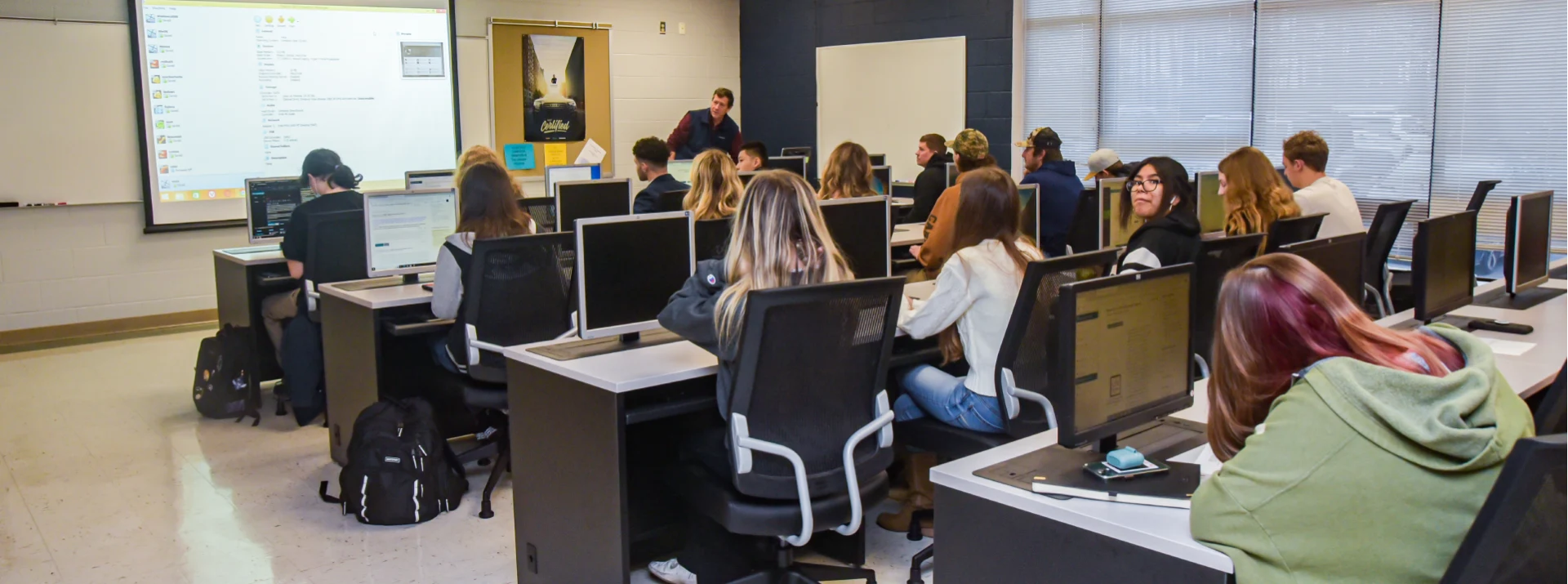
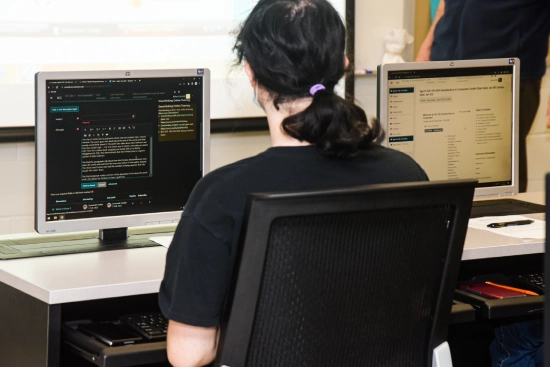

Information Technology Diploma Image
small-image

Information Systems (C25590SP)

The Information Technology (IT) curriculum prepares graduates for employment in the technology sector as designers, testers, support technicians, system administrators developers, or programmers who use computer software and/or hardware to design, process, implement and manage information systems in specialties such as database services, security, business intelligence, healthcare informatics and others depending on the technical path selected within this curriculum.

Semesters

Saved courses will be emailed to you. Click the ribbon after each title to select.

Class room image
First Fall Semester

Introduction to Computers

This course introduces computer concepts, including fundamental functions and operations of the computer. Topics include identification of hardware components, basic computer operations, security issues, and use of software applications. Upon completion, students should be able to demonstrate an understanding of the role and function of computers and use the computer to solve problems. This course has been approved for transfer under the CAA and ICAA as a general education course in Mathematics (Quantitative Option) in the AA & AS degrees.

CIS 110

Length: 2
Credits: 3
Lecture: 2
Lab: 2

Info Sys Business Concepts

The course introduces the role of IT in managing business processes and the need for business process and IT alignment. Emphasis is placed on industry need for understanding business challenges and developing/managing information systems to contribute to the decision-making process based on these challenges. Upon completion, students should be able to demonstrate knowledge of the ‘hybrid business manager’ and the potential offered by new technology and systems.

CTS 115

Length: 3
Credits: 3
Lecture: 3

Network & Security Foundation

This course introduces students to the Network concepts, including networking terminology and protocols, local and wide area networks, and network standards. Emphasis is placed on securing information systems and the various implementation policies. Upon completion, students should be able to perform basic tasks related to networking mathematics, terminology, media and protocols.

CTI 120

Length: 2
Credits: 3
Lecture: 2
Lab: 2
Semester Total 9
First Spring Semester

Hardware/Software Support

This course covers the basic hardware of a personal computer, including installation, operations and interactions with software. Topics include component identification, memory-system, peripheral installation and configuration, preventive maintenance, hardware diagnostics/repair, installation and optimization of system software, commercial programs, system configuration, and device-drivers. Upon completion, students should be able to select appropriate computer equipment and software, upgrade/maintain existing equipment and software, and troubleshoot/repair non-functioning personal computers.

CTS 120

Length: 2
Credits: 3
Lecture: 2
Lab: 3

Security Concepts

This course introduces the concepts and issues related to securing information systems and the development of policies to implement information security controls. Topics include the historical view of networking and security, security issues, trends, security resources, and the role of policy, people, and processes in information security. Upon completion, students should be able to identify information security risks, create an information security policy, and identify processes to implement and enforce policy.

SEC 110

Prerequisites:

CIS 110

This course introduces computer concepts, including fundamental functions and operations of the computer. Topics include identification of hardware components, basic computer operations, security issues, and use of software applications. Upon completion, students should be able to demonstrate an understanding of the role and function of computers and use the computer to solve problems. This course has been approved for transfer under the CAA and ICAA as a general education course in Mathematics (Quantitative Option) in the AA & AS degrees.

Length: 2
Credits: 3
Lecture: 2
Lab: 2
Semester Total 6
Total Program Credit 15

SALARY POTENTIAL

Entry-Level Roles

$40,000 – $55,000/year

Solid starting point with high potential for growth into specialized roles. Excellent for gaining foundational experience.

Moderate demand

93% of graduates find work within 6 months

Mid-Level Roles

$65,000 – $85,000/year

Strong progression path with options in corporate finance, public accounting, or government. Certifications (e.g., CPA, CFA) enhance mobility.

High demand

96% employed within 3–6 months post-certification.

Specialist Roles

$100,000 – $180,000+/year

Leadership and strategic roles with influence on business decisions. High long-term stability and career satisfaction.

Very high demand

97% with strong job security and lateral mobility.

Start your Path

Bring your goal to life

STUDENT STORY

Caroline Bailey

Congratulations to Caroline Bailey for being named as a BCC Student of the Month. “In every way, Caroline represents the best of BCC,” said Instructor Heather Hardie. “She’s a team player, hard worker, and has a heart of gold. Her passion for learning and helping others inspires us all.”

Find your path

Need Help Choosing?

Not sure which program is right for you? Our Success Coaches are here to help.

OneStop Student Services, Building A, Brunswick Community College

(910) 755-7320 | onestop@brunswickcc.edu

Close

TELL US ABOUT YOURSELF.

WHAT INTERESTS YOU? (CHOOSE UP TO 3)

WHAT CREDENTIAL ARE YOU HOPING TO EARN?

In about two years, you can earn an Associate of Arts, Associate of Science, or an Associate of Applied Science degree. Many students continue their education at a four-year college or university.
A diploma takes less time (9-18 months) than a degree and provides you with hands-on training and skills in a specific field. You are workforce ready.
If you want focused training in a specific skill or industry in less than one year, a certificate program may be for you.
In less than six months, you train for employment in a specific field or career type, short-term industry training programs are a great place to start. Some programs offer industry recognized credentials.
High School students can accelerate the completion of college certificates, diplomas, and associate degrees.
Complete a high school credential (GED®) that mirrors a public-school credential.
Prepares adults to take the High School Equivalency Test.

HOW WOULD YOU PREFER TO LEARN?

WHEN WOULD YOU LIKE TO COMPLETE YOUR PROGRAM?

BASED ON YOUR RESPONSES, THESE PROGRAMS MAY BE A GREAT FIT FOR YOU.

Every student's path is different. Explore these recommended programs to learn more about the opportunities available at Brunswick Community College.

Find your pathways and take the next step forward

Wherever you’re starting, we’re here to help you take the next step.

Pathways Wizard is your personal academic navigator—helping you map out the right path to reach your goals and turn confusion into a clear plan forward.