


Emergency Medical Science Associate in Applied Science Degree (A45340)
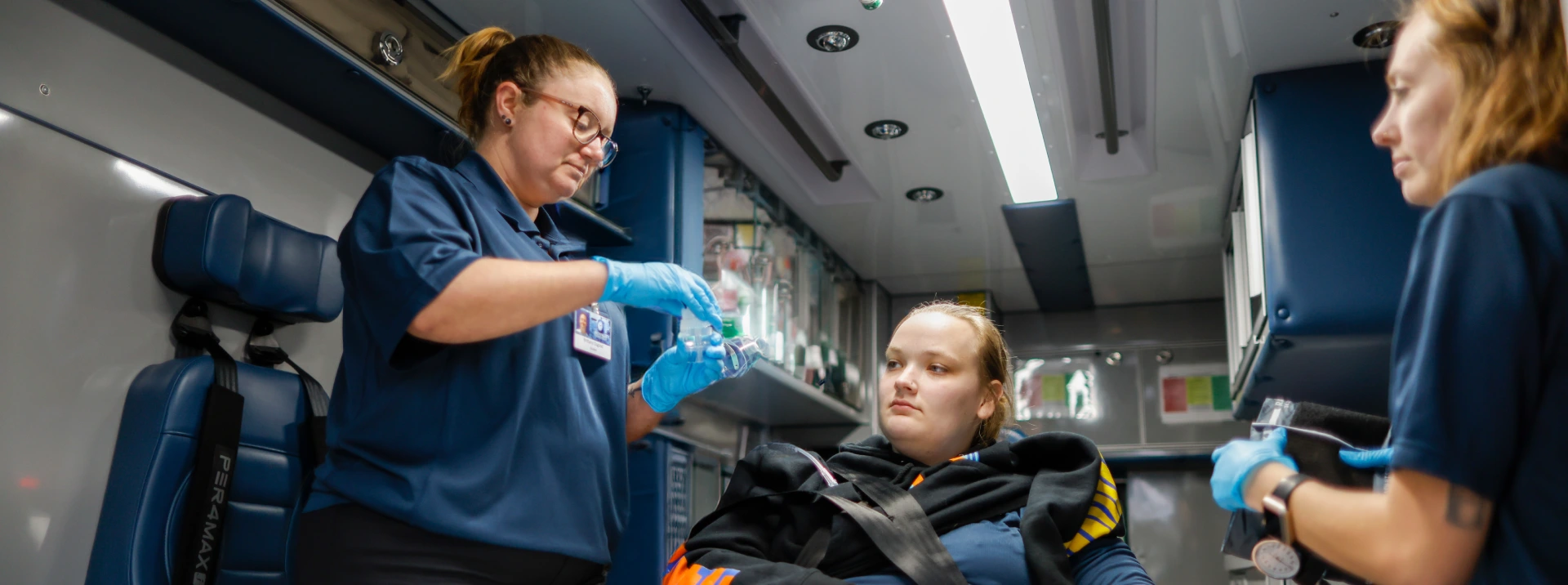
If you thrive on helping others, having a variety of workplace experiences, and think an ambulance is an ideal workplace, consider a career as a Paramedic. It’s challenging, fast-paced, and rewarding. It also offers an excellent wage and the opportunity to advance within the healthcare industry. Students will gain complex knowledge, competency, and experience while employing evidence-based practice under medical oversight.
Your first semester of training focuses on earning your Emergency Medical Technician (EMT) credentials before moving on to the final four semesters of the degree program. Through a mix of classroom and practical training, you will learn to access patients, treat wounds, splint traumatic injuries, provide intravenous (IV) therapy, administer medication, electrical therapy, and more. Students currently holding a valid EMT or Advanced EMT credential can get credit for certain EMS college courses.
Graduates of this program may be eligible to take state and/or national certification examinations. Employment opportunities include emergency medical services, fire departments, rescue agencies, hospital specialty areas, industry, educational, and government agencies.
Get started
If this sounds like you, we invite you to learn more about earning an Associate Degree in Applied Science and begin working as a Paramedic in as little as five semesters at BCC. Review the curriculum outline below, apply today or contact us to learn more. Note: If you’re already a Paramedic with current credentials but haven’t yet earned your degree, consider our Emergency Medical Science Degree Bridge Option. The EMS Bridge option can earn you up to 48 credit hours towards your EMS degree.
Brunswick Community College’s Emergency Medical Science program is approved by the North Carolina Office of Emergency Medical Services.
Paramedic Program Outcomes
CAAHEP Accredited Paramedic Programs and CoAEMSP Letter of Review (LoR) Programs track and report outcome measures annually to the Committee on Accreditation for the Emergency Medical Services Professions (CoAEMSP).
The most current CoAEMSP Annual Report requirement was for the calendar year 2025. The most recent success rate for the North Carolina state cognitive exam on the third take was 100% (calendar year 2025). The most recent positive placement rate for graduates was 100% (calendar year 2025). The most recent retention rate was 78.9% (calendar year 2025), based on one student exiting the program. Positive placement is defined by the CoAEMSP as “Employed full or part-time in a related field and/or continuing his/her education and/or serving in the military.” Positive placement is measured at completion of the program.
2023:
- Overall Retention rate for the Paramedic program was 85.7%
- NC State/National Registry Written Exam Pass Rate Success (after 1st attempt) was 100%
- Job Placement was 100%
2024:
- Overall Retention rate for the Paramedic program overall was 87.5%
- NC State/National Registry Written Exam Pass Rate Success (after 3rd attempt) was 100%
- Job Placement was 92.9%
2025:
- Overall Retention rate for the Paramedic program was 78.9%
- NC State/National Registry Written Exam Pass Rate Success (after 3rd attempt) was 100%
- Job Placement was 100%
Minimum Expectations Goal Statement: To prepare Paramedics who are competent in the cognitive (knowledge), psychomotor (skills), and affective (behavior) learning domains to enter the profession.
“The Brunswick Community College Paramedic program holds a letter of review, which is not a caahep accreditation status, but status granted by the committee on accreditation of educational programs for the emergency medical services professions (coaemsp) signifying that a program seeking inital accreditation has demonstrated sufficient compliance with the accreditation standards through the letter of review self study repoty (lssr) and other documentation. However, it is not a guarantee of eventual accreditation.”
To contact CoAEMSP:
214-703-8445
www.coaemsp.org

Semesters
Saved courses will be emailed to you. Click the ribbon after each title to select.

First Fall Semester
Anatomy & Physiology I
Writing and Inquiry
Advanced EMT
First Spring Semester
Anatomy & Physiology II
Pharmacology
Advanced Airway Mgmt
AEMT Clinical Practicum
EMS 121
This course provides the hospital and field internship/clinical experiences required in preparation for the Advanced EMT certification. Emphasis is placed on performing patient assessments, treatments, and interactions appropriate at the Advanced EMT level of care. Upon completion, students should be able to demonstrate competency at the Advanced EMT skill level.
EMS 122
This course provides the introductory hospital clinical experience for the paramedic student. Emphasis is placed on mastering fundamental paramedic skills. Upon completion, students should be able to demonstrate competency with fundamental paramedic level skills demonstrate competency at the Advanced EMT skill level.
First Summer Semester
Medical Emergencies
Cardiology II
EMS Clinical Practicum II
Second Fall Semester
EMS Clinical Practicum III
Trauma Emergencies
Life Span Emergencies
Patients w/Special Challenges
Select One
ENG 112
This course, the second in a series of two, introduces research techniques, documentation styles, and writing strategies. Emphasis is placed on analyzing information and ideas and incorporating research findings into documented writing and research projects. Upon completion, students should be able to evaluate and synthesize information from primary and secondary sources using documentation appropriate to various disciplines. This course has been approved for transfer under the CAA and ICAA as a pre-major and/or general education elective course requirement for the AA, AS or AE degrees. This is a Universal General Education Transfer Component (UGETC) course in English Composition for the AA, AE, and AS degrees.
ENG 114
This course, the second in a series of two, is designed to teach professional communication skills. Emphasis is placed on research, listening, critical reading and thinking, analysis, interpretation, and design used in oral and written presentations. Upon completion, students should be able to work individually and collaboratively to produce well-designed business and professional written and oral presentations. This course has been approved for transfer under the CAA and ICAA as a general education course in English Composition for the AA & AS degrees.
COM 120
This course introduces the practices and principles of interpersonal communication in both dyadic and group settings. Emphasis is placed on the communication process, perception, listening, self- disclosure, speech apprehension, ethics, nonverbal communication, conflict, power, and dysfunctional communication relationships. Upon completion, students should be able to demonstrate interpersonal communication skills, apply basic principles of group discussion, and manage conflict in interpersonal communication situations. This course has been approved for transfer under the CAA and ICAA as a general education course in Communications for the AA & AS degrees.
COM 231
This course provides instruction and experience in preparation and delivery of speeches within a public setting and group discussion. Emphasis is placed on research, preparation, delivery, and evaluation of informative, persuasive, and special occasion public speaking. Upon completion, students should be able to prepare and deliver well-organized speeches and participate in group discussion with appropriate audiovisual support. This course has been approved for transfer under the CAA and ICAA as a general education course in English Composition Communications) for the AA & AS degrees. This is a Universal General Education Transfer Component (UGETC) course in Communications for the AA & AS degrees.
Second Spring Semester
General Psychology
EMS Clinical Practicum IV
EMS Capstone
Humanities/Fine Arts Elective
HUM 115
This course introduces the use of critical thinking skills in the context of human conflict. Emphasis is placed on evaluating information, problem solving, approaching cross-cultural perspectives, and resolving controversies and dilemmas. Upon completion, students should be able to demonstrate orally and in writing the use of critical thinking skills in the analysis of appropriate texts. This course has been approved for transfer under the CAA and ICAA as a general education course in Humanities & Fine Arts for the AA & AS degrees.
PHI 215
This course introduces fundamental issues in philosophy considering the views of classical and contemporary philosophers. Emphasis is placed on knowledge and belief, appearance and reality, determinism and free will, faith and reason, and justice and inequality. Upon completion, students should be able to identify, analyze, and critically evaluate the philosophical components of an issue. This course has been approved for transfer under the CAA and ICAA as a pre-major and/or elective course requirement for the AA, AE, & AS degrees. This is a Universal General Education Transfer Component (UGETC) course in Humanities & Fine Arts for the AA, AE, & AS degrees.
PHI 240
This course introduces theories about the nature and foundations of moral judgments and applications to contemporary moral issues. Emphasis is placed on moral theories such as consequentialism, deontology, and virtue ethics. Upon completion, students should be able to apply various ethical theories to moral issues such as abortion, capital punishment, poverty, war, terrorism, the treatment of animals, and issues arising from new technologies. This course has been approved for transfer under the CAA and ICAA as a pre-major and/or elective course requirement for the AA, AE & AS degrees. This is a Universal General Education Transfer Component (UGETC) course in Humanities & Fine Arts for the AA & AE degrees.
Start your Path
Bring your goal to life


STUDENT STORY
Caroline Bailey
Congratulations to Caroline Bailey for being named as a BCC Student of the Month. “In every way, Caroline represents the best of BCC,” said Instructor Heather Hardie. “She’s a team player, hard worker, and has a heart of gold. Her passion for learning and helping others inspires us all.”