


Early Childhood Education Diploma (D55220P)
This curriculum is available to eligible high school students through the Career and College Promise Program.
Semesters
Saved courses will be emailed to you. Click the ribbon after each title to select.

First Fall Semester
Intro to Early Childhood Education
This course introduces the foundations of culturally responsive, equitable and inclusive early childhood education, planning intentional developmentally appropriate experiences, learning activities, and teaching strategies for indoor and outdoor environments for all young children, guidance techniques, and professionalism. Topics include theoretical foundations, national early learning standards, NC Foundations for Early Learning and Development, state regulations, program types, career options, professionalism, ethical conduct, quality inclusive environments, guidance techniques, and curriculum responsive to the needs of each child/family. Upon completion, students should be able to implement developmentally appropriate environments, guidance techniques, schedules, and teaching strategies across developmental domains to support culturally, linguistically, and ability diverse children and their families in inclusive settings, and design a personal career/professional development plan.
Child, Family, & Community
This course covers the development of partnerships among culturally, linguistically and ability diverse families, children, schools and communities through the use of evidence-based strategies. Emphasis is placed on developing skills and identifying benefits for establishing and supporting respectful relationships between diverse families, programs/schools, and community agencies/resources reflective of the NAEYC Code of Ethical Conduct and the Code of Ethics for North Carolina Educators. Upon completion, students should be able to identify appropriate relationship building strategies between diverse families, children birth through adolescence, schools, and communities and demonstrate a variety of communication skills including appropriate use of technology to support every child.
Child Guidance
This course provides an activity-based approach that develops measurement skills and mathematical literacy using technology to solve problems for non-math intensive programs. Topics include unit conversions and estimation within a variety of measurement systems; ratio and proportion; basic geometric concepts; financial literacy; and statistics including measures of central tendency, dispersion, and charting of data. Upon completion, students should be able to demonstrate the use of mathematics and technology to solve practical problems, and to analyze and communicate results.
Health, Safety, & Nutrition
This course covers promoting and maintaining the health and well-being of every child. Topics include health and nutritional guidelines, common childhood illnesses, maintaining safe and healthy learning environments, health benefits of active play, recognition and reporting of abuse/neglect, and state regulations. Upon completion, students should be able to apply knowledge of NC Foundations for Early Learning and Development for health, safety, nutritional needs and safe learning environments.
Transfer and Career Success
This course provides information and strategies necessary to develop clear academic and professional goals beyond the community college experience. Topics include the CAA, college policies and culture, career exploration, gathering information on senior institutions, strategic planning, critical thinking, and communications skills for a successful academic transition. Upon completion, students should be able to develop an academic plan to transition successfully to senior institutions. This course has been approved for transfer under the CAA and ICAA as a pre-major and/or elective course requirement for the AA, AE, & AS degrees.
Semester Total
14
First Spring Semester
Creative Activities
This course introduces developmentally supportive creative learning environments with attention to divergent thinking, creative problem-solving, evidence-based teaching practices, and open-ended learning materials while applying NC Foundations for Early Learning and Development. Emphasis is placed on observation of process driven learning experiences in art, music, creative movement, dance, and dramatics for every young child age birth through eight, integrated through all domains and academic content. Upon completion, students should be able to examine, create, and adapt developmentally creative learning materials, experiences, and environments for children that are culturally, linguistically, and ability diverse.
Writing and Inquiry
This course is designed to develop the ability to produce clear writing in a variety of genres and formats using a recursive process. Emphasis includes inquire, analysis, effective use of rhetorical strategies, thesis development, audience awareness, and revision. Upon completion, students should be able to produce unified, coherent, well-developed essays using standard written English. This course has been approved for transfer under the CAA and ICAA as a pre-major and/or general education elective course requirement for the AA, AS or AE degrees. This is a Universal General Education Transfer Component (UGETC) course in English Composition for the AA, AE, and AS degrees.
Child Development I
This course includes the theories of child development, observation and assessment, milestones, and factors that influence development, from conception through approximately 36 months. Emphasis is placed on knowledge, observation and assessment of developmental sequences in approaches to play/learning, emotional/social, health/physical, language/communication and cognitive domains. Upon completion, students should be able to compare/contrast typical/atypical developmental characteristics, explain biological and environmental factors that impact development, and identify evidence-based strategies for enhancing development for children that are culturally, linguistically, and ability diverse. This course has been approved for transfer under the CAA and ICAA as a pre-major and/or elective course requirement or the AA & AS degrees.
Child Development II
This course includes the theories of child development, observation and assessment, milestones, and factors that influence development, from preschool through middle childhood. Emphasis is placed on knowledge, observation and assessment of developmental sequences in approaches to play/learning, emotional/social, health/physical, language/communication and cognitive domains. Upon completion, students should be able to compare/contrast typical/atypical developmental characteristics, explain biological and environmental factors that impact development and identify evidence-based strategies for enhancing development for children that are culturally, linguistically, and ability diverse. This course has been approved for transfer under the CAA and ICAA as a pre-major and/or elective course requirement or the AA & AS degrees.
Semester Total
12
Second Fall Semester
Children with Exceptionalities
This course covers atypical patterns of child development, inclusive/diverse settings, evidenced-based education/family plans, differentiated instruction, adaptive materials, and assistive technology. Emphasis is place on the characteristics of exceptionalities and delays, early intervention/special education, transitions, observation, developmental screening, formative assessment of children, and collaborating with families and community partners. Upon completion, students should be able to recognize diverse abilities, describe the referral process, identify community resources, explain the importance of collaboration with families/professionals and develop appropriate strategies/adaptations to support children in all environments with best practices as defined by lase, policies and NC Foundations for Early Learning and Development. This course has been approved for transfer under the CAA and ICAA as a pre-major and/or elective course requirement or the AA & AS degrees.
Infants, Toddlers, & Twos
This course covers the development of high-quality, individualized, responsive/engaging relationships and experiences for infants, toddlers, and twos. Emphasis is placed on typical and atypical child development, working with diverse families to provide positive, supportive, and engaging early learning activities and interactions through field experiences and the application of the NC Foundations for Early Learning and Development. Upon completion, students should be able to demonstrate responsive curriculum planning, respectful relationships and exposure to a variety of developmentally appropriate experiences/materials that support a foundation for healthy development and growth of culturally, linguistically and ability diverse children birth to 36 months.
Language & Literacy Experience
This course provides evidence-based strategies for enhancing language and literacy experiences that align with NC Foundations for Early Learning and Development. Topics include developmental sequences for children’s emergent receptive and expressive language, print concepts, appropriate observations/assessments, literacy enriched environments, quality selection of diverse literature, interactive media, and inclusive practices. Upon completion, students should be able to select, plan, implement and evaluate developmentally appropriate language and literacy experiences for children who are culturally, linguistically and ability diverse.
General Psychology
This course provides an overview of the scientific study of human behavior. Topics include history, methodology, biopsychology, sensation, perception, learning, motivation, cognition, abnormal behavior, personality theory, social psychology, and other relevant topics. Upon completion, students should be able to demonstrate a basic knowledge of the science of psychology. This course has been approved for transfer under the CAA and ICAA as a pre-major and/or elective course requirement for the AA, AE, & AS degrees. This is a Universal General Education Transfer Component (UGETC) course in Social & Behavioral Sciences for the AA, AE, & AS degrees.
Semester Total
12
Total Program Credit
38
Start your Path
Bring your goal to life


STUDENT STORY
Caroline Bailey
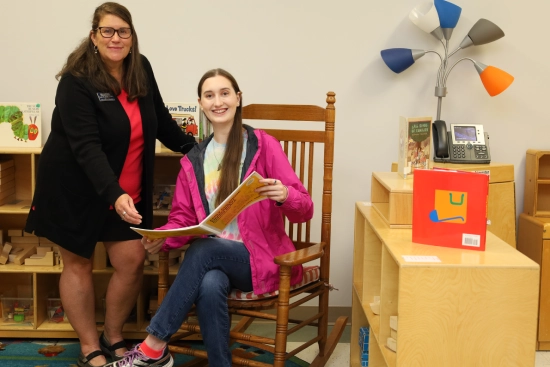
Congratulations to Caroline Bailey for being named as a BCC Student of the Month. “In every way, Caroline represents the best of BCC,” said Instructor Heather Hardie. “She’s a team player, hard worker, and has a heart of gold. Her passion for learning and helping others inspires us all.”