

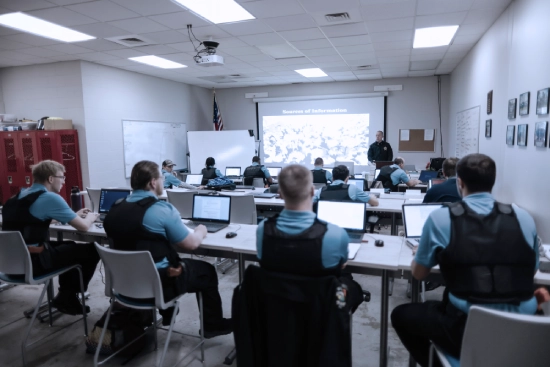

Criminal Justice Technology Diploma (D55180P)
This curriculum is available to eligible high school students through the Career and College Promise Program.
Semesters
Saved courses will be emailed to you. Click the ribbon after each title to select.

First Fall Semester
Writing and Inquiry
This course is designed to develop the ability to produce clear writing in a variety of genres and formats using a recursive process. Emphasis includes inquire, analysis, effective use of rhetorical strategies, thesis development, audience awareness, and revision. Upon completion, students should be able to produce unified, coherent, well-developed essays using standard written English. This course has been approved for transfer under the CAA and ICAA as a pre-major and/or general education elective course requirement for the AA, AS or AE degrees. This is a Universal General Education Transfer Component (UGETC) course in English Composition for the AA, AE, and AS degrees.
Introduction to Criminal Justice
This course introduces the components and processes of the criminal justice system. Topics include history, structure, functions, and philosophy of the criminal justice system and their relationship to life in our society. Upon completion, Students should be able to define and describe the major system components and their interrelationships and evaluate career options. This course has been approved for transfer under the CAA and ICAA as a pre-major and/or elective course requirement for the AA & AS degrees.
Criminology
This course introduces deviant behavior as it relates to criminal activity. Topics include theories of crime causation; statistical analysis of criminal behavior; past, present, and future social control initiatives; and other related topics. Upon completion, students should be able to explain and discuss various theories of crime causation and societal response.
Semester Total
9
First Spring Semester
Constitutional Law
The course covers the impact of the Constitution of the United States and its amendments on the criminal justice system. Topics include the structure of the Constitution and its amendments, court decisions pertinent to contemporary criminal justice issues, and other related topics. Upon completion, students should be able to identify/discuss the basic structure of the United States Constitution and the rights/procedures as interpreted by the courts.
Introduction to Computers
This course introduces computer concepts, including fundamental functions and operations of the computer. Topics include identification of hardware components, basic computer operations, security issues, and use of software applications. Upon completion, students should be able to demonstrate an understanding of the role and function of computers and use the computer to solve problems. This course has been approved for transfer under the CAA and ICAA as a general education course in Mathematics (Quantitative Option) in the AA & AS degrees.
Corrections
This course covers the history, major philosophies, components, and current practices and problems of the field of corrections. Topics include historical evolution, functions of the various components, alternatives to incarceration, treatment programs, inmate control, and other related topics. Upon completion, students should be able to explain the various components, processes, and functions of the correctional system. This course has been approved for transfer under the CAA and ICAA as a pre-major and/or elective course requirement for the AA & AS degrees.
Semester Total
9
Second Fall Semester
Juvenile Justice
This course covers the juvenile justice system and related juvenile issues. Topics include an overview of the juvenile justice system, treatment and prevention programs, special areas and laws unique to juveniles, and other related topics. Upon completion, students should be able to identify/discuss juvenile court structure/procedures, function and jurisdiction of juvenile agencies, processing/detention of juveniles, and case disposition.
Ethics & Comm Relations
This course covers ethical considerations and accepted standards applicable to criminal justice organizations and professionals. Topics include ethical systems; social change, values, and norms; cultural diversity; citizen involvement in criminal justice issues; and other related topics. Upon completion, students should be able to apply ethical considerations to the decision-making process in identifiable criminal justice situations.
Victimology
This course introduces the study of victims. Emphasis is placed on roles/characteristics of victims, victim interaction with the criminal justice system and society, current victim assistance programs, and other related topics. Upon completion, students should be able to discuss and identify victims, the uniqueness of victims’ roles, and current victim assistance programs.
Semester Total
9
Second Spring Semester
Public Speaking
This course provides instruction and experience in preparation and delivery of speeches within a public setting and group discussion. Emphasis is placed on research, preparation, delivery, and evaluation of informative, persuasive, and special occasion public speaking. Upon completion, students should be able to prepare and deliver well-organized speeches and participate in group discussion with appropriate audiovisual support. This course has been approved for transfer under the CAA and ICAA as a general education course in English Composition Communications) for the AA & AS degrees. This is a Universal General Education Transfer Component (UGETC) course in Communications for the AA & AS degrees.
Substance Abuse
This course is a study of substance abuse in our society. Topics include the history and classifications of drug abuse and the social, physical, and psychological impact of drug abuse. Upon completion, students should be able to identify various types of drugs, their effects on human behavior and society, and treatment modalities.
Law Enfor Mgt & Supervis
This course provides a study of the best known methods and practices of police leadership and management. Topics include the role of the manager in law enforcement, communications, time-management in law enforcement, managing problems, training and law enforcement productivity. Upon completion, students should be able to identify and discuss methods and practices capable of moving law enforcement agencies forward into the twenty-first century.
Semester Total
9
Total Program Credit
36
Start your Path
Bring your goal to life


STUDENT STORY
Caroline Bailey
Congratulations to Caroline Bailey for being named as a BCC Student of the Month. “In every way, Caroline represents the best of BCC,” said Instructor Heather Hardie. “She’s a team player, hard worker, and has a heart of gold. Her passion for learning and helping others inspires us all.”