

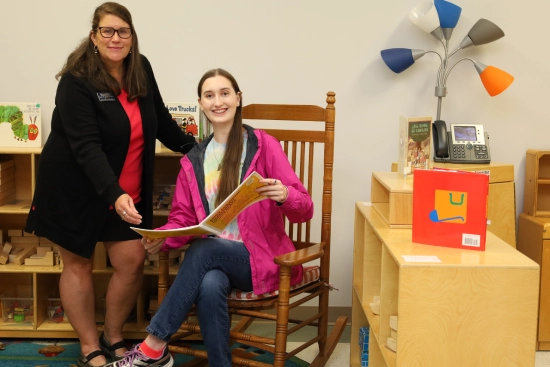

Early Childhood Education Diploma Image
small-image

Early Childhood Education Administration Certificate (C55220A)

The Early Childhood Education curriculum prepares individuals to work with children from birth through eight in diverse learning environments. Students will combine learned theories with practice in actual settings with young children under the supervision of qualified teachers.

Coursework includes child growth and development; physical/nutritional needs of children; care and guidance of children; and communication skills with families and children. Students will foster the cognitive/language, physical/motor, social/emotional, and creative development of young children.

Graduates are prepared to plan and implement developmentally appropriate programs in early childhood settings. Employment opportunities include child development and child care programs, preschools, public and private schools, recreational centers, Head Start Programs, and school-age programs.

Semesters

Saved courses will be emailed to you. Click the ribbon after each title to select.

Class room image
First Fall Semester

Intro to Early Childhood Education

This course introduces the foundations of culturally responsive, equitable and inclusive early childhood education, planning intentional developmentally appropriate experiences, learning activities, and teaching strategies for indoor and outdoor environments for all young children, guidance techniques, and professionalism. Topics include theoretical foundations, national early learning standards, NC Foundations for Early Learning and Development, state regulations, program types, career options, professionalism, ethical conduct, quality inclusive environments, guidance techniques, and curriculum responsive to the needs of each child/family. Upon completion, students should be able to implement developmentally appropriate environments, guidance techniques, schedules, and teaching strategies across developmental domains to support culturally, linguistically, and ability diverse children and their families in inclusive settings, and design a personal career/professional development plan.

EDU 119

Length: 4
Credits: 4
Lecture: 4

Health, Safety, & Nutrition

This course covers promoting and maintaining the health and well-being of every child. Topics include health and nutritional guidelines, common childhood illnesses, maintaining safe and healthy learning environments, health benefits of active play, recognition and reporting of abuse/neglect, and state regulations. Upon completion, students should be able to apply knowledge of NC Foundations for Early Learning and Development for health, safety, nutritional needs and safe learning environments.

EDU 153

Length: 3
Credits: 3
Lecture: 3
Semester Total 7
First Spring Semester

Child Development I

This course includes the theories of child development, observation and assessment, milestones, and factors that influence development, from conception through approximately 36 months. Emphasis is placed on knowledge, observation and assessment of developmental sequences in approaches to play/learning, emotional/social, health/physical, language/communication and cognitive domains. Upon completion, students should be able to compare/contrast typical/atypical developmental characteristics, explain biological and environmental factors that impact development, and identify evidence-based strategies for enhancing development for children that are culturally, linguistically, and ability diverse. This course has been approved for transfer under the CAA and ICAA as a pre-major and/or elective course requirement or the AA & AS degrees.

EDU 144

Length: 3
Credits: 3
Lecture: 3

Early Childhood Administration I

This course introduces principles and practices essential to preparing and supporting child care administrators. Topics include program philosophy, policies and procedures, NC Child Care Law and Rules, business planning, personnel and fiscal management, and NAEYC Code of Ethical Conduct Supplement for Early Childhood Program Administration. Upon completion, students should be able to articulate a developmentally appropriate program philosophy, locate current state licensing regulations, analyze a business plan and examine comprehensive program policies and procedures.

EDU 261

Prerequisites:

ENG 025

This course provides the skills necessary for success in college English courses. Topics include reading and writing processes and strategies, such as critical thinking, text analysis, idea development, and application of writing conventions. Upon completion, students should be able to analyze readings and produce unified, coherent, well developed paragraphs and essays using appropriate document design and standard written English while developing positive academic habits, learning strategies, and a growth mindset.

Corequisites:

EDU 119

This course introduces the foundations of culturally responsive, equitable and inclusive early childhood education, planning intentional developmentally appropriate experiences, learning activities, and teaching strategies for indoor and outdoor environments for all young children, guidance techniques, and professionalism. Topics include theoretical foundations, national early learning standards, NC Foundations for Early Learning and Development, state regulations, program types, career options, professionalism, ethical conduct, quality inclusive environments, guidance techniques, and curriculum responsive to the needs of each child/family. Upon completion, students should be able to implement developmentally appropriate environments, guidance techniques, schedules, and teaching strategies across developmental domains tosupport culturally, linguistically, and ability diverse children and their families in inclusive settings, and design a personal career/professional development plan.

Length: 3
Credits: 3
Lecture: 3

Early Childhood Administration II

This course focuses on advocacy/leadership, public relations/community outreach and program quality/evaluation for diverse early childhood programs. Topics include program evaluation/accreditation, involvement in early childhood professional organizations, leadership/mentoring, family, volunteer and community involvement and early childhood advocacy. Upon completion, students should be able to define and evaluate all components of early childhood programs, develop strategies for advocacy and integrate community into programs.

EDU 262

Prerequisites:

ENG 025

This course provides the skills necessary for success in college English courses. Topics include reading and writing processes and strategies, such as critical thinking, text analysis, idea development, and application of writing conventions. Upon completion, students should be able to analyze readings and produce unified, coherent, well developed paragraphs and essays using appropriate document design and standard written English while developing positive academic habits, learning strategies, and a growth mindset.

,

EDU 119

This course introduces the foundations of culturally responsive, equitable and inclusive early childhood education, planning intentional developmentally appropriate experiences, learning activities, and teaching strategies for indoor and outdoor environments for all young children, guidance techniques, and professionalism. Topics include theoretical foundations, national early learning standards, NC Foundations for Early Learning and Development, state regulations, program types, career options, professionalism, ethical conduct, quality inclusive environments, guidance techniques, and curriculum responsive to the needs of each child/family. Upon completion, students should be able to implement developmentally appropriate environments, guidance techniques, schedules, and teaching strategies across developmental domains tosupport culturally, linguistically, and ability diverse children and their families in inclusive settings, and design a personal career/professional development plan.

and

EDU 261

This course introduces principles and practices essential to preparing and supporting child care administrators. Topics include program philosophy, policies and procedures, NC Child Care Law and Rules, business planning, personnel and fiscal management, and NAEYC Code of Ethical Conduct Supplement for Early Childhood Program Administration. Upon completion, students should be able to articulate a developmentally appropriate program philosophy, locate current state licensing regulations, analyze a business plan and examine comprehensive program policies and procedures.

Length: 3
Credits: 3
Lecture: 3
Semester Total 9
Total Program Credit 16
BrunswickComCol_WebsiteAsset_FlowerLady_HeadRoom
BrunswickComCol_WebsiteAsset_Mobile_Trophy_HeadRoom

STUDENT STORY

Caroline Bailey

Congratulations to Caroline Bailey for being named as a BCC Student of the Month. “In every way, Caroline represents the best of BCC,” said Instructor Heather Hardie. “She’s a team player, hard worker, and has a heart of gold. Her passion for learning and helping others inspires us all.”

Find your path

Need Help Choosing?

Not sure which program is right for you? Our Success Coaches are here to help.

OneStop Student Services, Building A, Brunswick Community College

(910) 755-7320 | onestop@brunswickcc.edu

Close

TELL US ABOUT YOURSELF.

WHAT INTERESTS YOU? (CHOOSE UP TO 3)

WHAT CREDENTIAL ARE YOU HOPING TO EARN?

In about two years, you can earn an Associate of Arts, Associate of Science, or an Associate of Applied Science degree. Many students continue their education at a four-year college or university.
A diploma takes less time (9-18 months) than a degree and provides you with hands-on training and skills in a specific field. You are workforce ready.
If you want focused training in a specific skill or industry in less than one year, a certificate program may be for you.
In less than six months, you train for employment in a specific field or career type, short-term industry training programs are a great place to start. Some programs offer industry recognized credentials.
High School students can accelerate the completion of college certificates, diplomas, and associate degrees.
Complete a high school credential (GED®) that mirrors a public-school credential.
Prepares adults to take the High School Equivalency Test.

HOW WOULD YOU PREFER TO LEARN?

WHEN WOULD YOU LIKE TO COMPLETE YOUR PROGRAM?

BASED ON YOUR RESPONSES, THESE PROGRAMS MAY BE A GREAT FIT FOR YOU.

Every student's path is different. Explore these recommended programs to learn more about the opportunities available at Brunswick Community College.

Find your pathways and take the next step forward

Wherever you’re starting, we’re here to help you take the next step.

Pathways Wizard is your personal academic navigator—helping you map out the right path to reach your goals and turn confusion into a clear plan forward.