

Associate in Engineering (A10500)
The AE degree plan includes required general education and prerequisite courses that are acceptable to all state funded Bachelor of Engineering programs.
Students who follow the degree progression plan will meet the entrance requirements at all of the North Carolina public Bachelor of Science Engineering programs. Associate in Engineering graduates may then apply to any of these programs without taking additional and sometimes duplicative courses.
Semesters
Saved courses will be emailed to you. Click the ribbon after each title to select.

First Fall Semester
Transfer and Career Success
Writing and Inquiry
Calculus I
Principles of Microeconomics
General Chemistry I
First Spring Semester
Writing/Research in the Disciplines
General Physics I
Calculus II
Introduction to Engineering
Social/Behavioral Sciences UGETC Elective
HIS 111
This course introduces world history from the dawn of civilization to the early modern era. Topics include Eurasian, African, American, and Greco-Roman civilizations and Christian, Islamic and Byzantine cultures. Upon completion, students should be able to analyze significant political, socioeconomic, and cultural developments in pre-modern world civilizations. This course has been approved for transfer under the CAA and ICAA as a general education course in Social & Behavioral Sciences for the AA, AE, & AS degrees. Â This is a Universal General Education Transfer Component (UGETC) course in Social & Behavioral Sciences for the AA, AE, & AS degrees.
HIS 112
This course introduces world history from the early modern era to the present. Topics include the cultures of Africa, Europe, India, China, Japan, and the Americas. Upon completion, students should be able to analyze significant political, socioeconomic, and cultural developments in modern world civilizations. This course has been approved for transfer under the CAA and ICAA as a general education course in Social & Behavioral Sciences for the AA, AE, & AS degrees  This is a Universal General Education Transfer Component (UGETC) course in Social & Behavioral Sciences for the AA, AE, & AS degrees.
HIS 131
This course is a survey of American history from pre-history through the Civil War era. Topics include the migrations to the Americas, the colonial and revolutionary periods, the development of the Republic, and the Civil War. Upon completion, students should be able to analyze significant political, socioeconomic, and cultural developments in early American history. This course has been approved for transfer under the CAA and ICAA as a general education course in Social & Behavioral Sciences for the AA, AE, & AS degrees. This is a Universal General Education Transfer Component (UGETC) course in Social & Behavioral Sciences for the AA, AE, & AS degrees.
HIS 132
This course is a survey of American history from the Civil War era to the present. Topics include industrialization, immigration, the Great Depression, the major American wars, the Cold War, and social conflict. Upon completion, students should be able to analyze significant political, socioeconomic, and cultural developments in American history since the Civil War. This course has been approved for transfer under the CAA and ICAA as a general education course in Social & Behavioral Sciences for the AA, AE, & AS degrees. This is a Universal General Education Transfer Component (UGETC) course in Social & Behavioral Sciences for the AA, AE, & AS degrees.
POL 120
This course is a study of the origins, development, structure, and functions of American national government. Topics include the constitutional framework, federalism, the three branches of government including the bureaucracy, civil rights and liberties, political participation and behavior, and policy process. Upon completion, students should be able to demonstrate an understanding of the basic concepts and participatory processes of the American political system. This course has been approved for transfer under the CAA and ICAA as a pre-major and/or elective course requirement for the AA & AS degrees. This is a Universal General Education Transfer Component (UGETC) course in Social & Behavioral Sciences for the AA, AE, & AS degrees.
PSY 150
This course provides an overview of the scientific study of human behavior. Topics include history, methodology, biopsychology, sensation, perception, learning, motivation, cognition, abnormal behavior, personality theory, social psychology, and other relevant topics. Upon completion, students should be able to demonstrate a basic knowledge of the science of psychology. This course has been approved for transfer under the CAA and ICAA as a pre-major and/or elective course requirement for the AA, AE, & AS degrees. This is a Universal General Education Transfer Component (UGETC) course in Social & Behavioral Sciences for the AA, AE, & AS degrees.
SOC 210
This course introduces the scientific study of human society, culture, and social interactions. Topics include socialization, research methods, diversity and inequality, cooperation and conflict, social change, social institutions, and organizations. Upon completion, students should be able to demonstrate knowledge of sociological concepts as they apply to the interplay among individuals, groups, and societies. This course has been approved for transfer under the CAA and ICAA as a pre-major and/or elective course requirement for the AA & AS degrees. This is a Universal General Education Transfer Component (UGETC) course in Social & Behavioral Sciences for the AA & AS degrees.
Second Fall Semester
Calculus III
General Physics II
Humanities/Fine Arts UGETC Elective
ENG 231
This course covers selected works in American literature from its beginnings to 1865. Emphasis is placed on historical background, cultural context, and literary analysis of selected prose, poetry, and drama. Upon completion, students should be able to analyze and interpret literary works in their historical and cultural contexts. This course has been approved for transfer under the CAA and ICAA as a pre-major and/or general education elective course requirement for the AA, AS or AE degrees. This is a Universal General Education Transfer Component (UGETC) course in Humanities & Fine Arts for the AA & AS degrees.
ENG 232
This course covers selected works in American literature from 1865 to the present. Emphasis is placed on historical background, cultural context, and literary analysis of selected prose, poetry, and drama. Upon completion, students should be able to analyze and interpret literary works in their historical and cultural contexts. This course has been approved for transfer under the CAA and ICAA as a pre-major and/or general education elective course requirement for the AA, AE, or AS degrees. This is a Universal General Education Transfer Component (UGETC) course in Humanities & Fine Arts for the AA, AE, & AS degrees.
ENG 241
This course covers selected works in British literature from its beginnings to the Romantic Period. Emphasis is placed on historical background, cultural context, and literary analysis of selected prose, poetry, and drama. Upon completion, students should be able to interpret, analyze, and respond to literary works in their historical and cultural contexts. This course has been approved for transfer under the CAA and I CAA as a general education course in Humanities & Fine Arts for the AA, AE, & AS degrees. This is a Universal General Education Transfer Component (UGETC) course in Humanities & Fine Arts for the AA, AE, & AS degrees.
ENG 242
This course covers selected works in British literature from the Romantic Period to the present. Emphasis is placed on historical background, cultural context, and literary analysis of selected prose, poetry, and drama. Upon completion, students should be able to interpret, analyze, and respond to literary works in their historical and cultural contexts. This course has been approved for transfer under the CAA as a general education course in Humanities & Fine Arts for the AA, AE, & AS degrees. This is a Universal General Education Transfer Component (UGETC) course in Humanities & Fine Arts for the AA, AE, & AS degrees.
PHI 215
This course introduces fundamental issues in philosophy considering the views of classical and contemporary philosophers. Emphasis is placed on knowledge and belief, appearance and reality, determinism and free will, faith and reason, and justice and inequality. Upon completion, students should be able to identify, analyze, and critically evaluate the philosophical components of an issue. This course has been approved for transfer under the CAA and ICAA as a pre-major and/or elective course requirement for the AA, AE, & AS degrees. This is a Universal General Education Transfer Component (UGETC) course in Humanities & Fine Arts for the AA, AE, & AS degrees.
PHI 240
This course introduces theories about the nature and foundations of moral judgments and applications to contemporary moral issues. Emphasis is placed on moral theories such as consequentialism, deontology, and virtue ethics. Upon completion, students should be able to apply various ethical theories to moral issues such as abortion, capital punishment, poverty, war, terrorism, the treatment of animals, and issues arising from new technologies. This course has been approved for transfer under the CAA and ICAA as a pre-major and/or elective course requirement for the AA, AE & AS degrees. This is a Universal General Education Transfer Component (UGETC) course in Humanities & Fine Arts for the AA & AE degrees.
REL 110
This course introduces the worldâs major religious traditions. Topics include Primal religions, Hinduism, Buddhism, Islam, Judaism, and Christianity. Upon completion, students should be able to identify the origins, history, beliefs, and practices of the religions studied. This course has been approved for transfer under the CAA and ICAA as a general education course in Humanities & Fine Arts for the AA, AE, & AS degrees.
Pre-major Course
Student selects courses based on their intended major and transfer university. Courses may not be duplicated from other degree components.
BIO 111
This course introduces the principles and concepts of biology. Emphasis is placed on basic biological chemistry, molecular and cellular biology, metabolism and energy transformation, genetics, evolution, and other related topics. Upon completion, students should be able to demonstrate understanding of life at the molecular and cellular levels. This course has been approved for transfer under the CAA and ICAA as a pre-major and/or general education elective course requirement for the AA, AE, & AS degrees. This is a Universal General Education Transfer Component (UGETC) course in Natural Sciences for the AA, AE, & AS degrees.
CHM 152
This course provides a continuation of the study of the fundamental principles and laws of chemistry. Topics include kinetics, equilibrium, ionic and redox equations, acid-base theory, electrochemistry, thermodynamics, introduction to nuclear and organic chemistry, and complex ions. Upon completion, students should be able to demonstrate an understanding of chemical concepts as needed to pursue further study in chemistry and related professional fields. This course has been approved for transfer under the CAA and ICAA as a general education course in Natural Science for the AA, AE, & AS degrees. This is a Universal General Education Transfer Component (UGETC) course in Natural Sciences for the AS degree.
CHM 251
This course provides a systematic study of the theories, principles, and techniques of organic chemistry. Topics include nomenclature, structure, properties, reactions, and mechanisms of hydrocarbons, alkyl halides, alcohols, and ethers; further topics include isomerization, stereochemistry, and spectroscopy. Upon completion, students should be able to demonstrate an understanding of the fundamental concepts of covered organic topics as needed inCHM 252. This course has been approved for transfer under the CAA and ICAA as a pre- major and/or elective course requirement for the AA & AS degree.
CHM 252
This course provides continuation of the systematic study of the theories, principles, and techniques of organic chemistry. Topics include nomenclature, structure, properties, reactions, and mechanisms of aromatics, aldehydes, ketones, carboxylic acids and derivatives, amines and heterocycles; multi-step synthesis will be emphasized. Upon completion, students should be able to demonstrate an understanding of organic concepts as needed to pursue further study in chemistry and related professional fields. This course has been approved for transfer under the CAA and ICAA as a pre- major and/or elective course requirement for the AA & AS degrees.
CSC 134
This course introduces computer programming using the C++ programming language with object-oriented programming principles. Emphasis is placed on event-driven programming methods, including creating and manipulating objects, classes, and using object-oriented tools such as the class debugger. Upon completion, students should be able to design, code, test and debug at a beginning level. This course has been approved for transfer under the CAA and ICAA as a pre-major and/or elective course requirement for the AA, AE, & AS degrees.
CSC 151
This course introduces computer programming using the JAVA programming language with object-oriented programming principles. Emphasis is placed on event-driven programming methods, including creating and manipulating objects, classes, and using object-oriented tools such as the class debugger. This course has been approved for transfer under the CAA and ICAA as a pre-major and/or elective course requirement for the AA, AE, & AS degree.
DFT 170
This course introduces basic engineering graphics skills and applications. Topics include sketching, selection, and use of current methods and tools, and the use of engineering graphics applications. Upon completion, students should be able to demonstrate an understanding of basic engineering graphics principles and practices. This course has been approved for transfer under the CAA and ICAA as a pre-major and/or elective course requirement or the AE & AS degrees.
EGR 210
This course provides an overview of electrical and computer engineering, through a lecture and laboratory setting. Topics include fundamental concepts, electronic circuits, digital circuits, communication systems, and signal processing. Upon completion, students should be able to discuss the wide range of fields available to the electrical or computer engineer. This course has been approved for transfer under the CAA and ICAA as a pre-major and/or elective course requirement for the AE or AS degrees.
EGR 212
This course provides an introduction to digital circuits and analysis. Topics include Boolean Algebra; mixed logic; design of combinational circuits; introduction to sequential systems; and MSI building blocks. Upon completion, students should be able to analyze and design digital circuits and systems. This course has been approved for transfer under the CAA and ICAA as a pre-major and/or elective course requirement for the AE or AS degrees.
EGR 215
This course provides an introduction to Kirchoffâs laws and terminal equations, circuit analysis techniques and network theorems, transient and natural response, and state variable analysis. Topics include Kirchoffâs laws, Ohmâs law, circuit analysis techniques, Network theorems, singularity functions, transient and natural responses, power, and state variable analysis. Upon completion, students should be able to analyze electric circuits involving capacitors, inductors, and resistors to determine required parameters. This course has been approved for transfer under the CAA and ICAA as a pre-major and/or elective course requirement for the AE or AS degrees.
EGR 216
This course provides laboratory experiments in network measurements and logic design and laboratory equipment and techniques. Topics include network measurement and applications, experimental logic design, and introduction to laboratory equipment and techniques. Upon completion, students should be able to complete network measurement logic design and be able to use laboratory equipment with proper techniques. This course has been approved for transfer under the CAA and ICAA as a pre-major and/or elective course requirement for the AE or AS degrees.
EGR 220
This course introduces the concepts of engineering based on forces in equilibrium. Topics include concentrated forces, distributed forces, forces due to friction, and inertia as they apply to machines, structures, and systems. Upon completion, students should be able to solve problems which require the ability to analyze systems of forces in static equilibrium. This course has been approved for transfer under the CAA and ICAA as a pre-major and/or elective course requirement for the AE or AS degrees.
EGR 225
This course introduces the concepts of engineering based on the analysis of motion in Cartesian, cylindrical, and spherical coordinate systems. Topics include the two and three dimensional motion of particles and rigid bodies, the forces associated with that motion, and relative motion between two coordinate systems. Upon completion, students should be able to solve problems which require the ability to analyze the motion and forces involved in a dynamic system. This course has been approved for transfer under the CAA and ICAA as a pre-major and/or elective course requirement for the AE or AS degrees.
EGR 228
This course provides an introduction to engineering theory of deformable solids and applications. Topics include stress and deformation resulting from axial, torsion, and bending loads; shear and moment diagrams; Mohrâs circle of stress; and strain and buckling of columns. Upon completion, students should be able to analyze solids subject to various forces and design systems using a variety of materials. This course has been approved for transfer under the CAA and ICAA as a pre-major and/or elective course requirement for the AE or AS degrees.
MAT 280
This course provides an introduction to linear algebra topics. Emphasis is placed on the development of abstract concepts and applications for vectors, systems of equations, matrices, determinants, vector spaces, multi- dimensional linear transformations, eigenvectors, eigenvalues, diagonalization and orthogonality. Upon completion, students should be able to demonstrate understanding of the theoretical concepts and select and use appropriate models and techniques for finding solutions to linear algebra-related problems with and without technology. This course has been approved for transfer under the CAA and ICAA as a pre- major and/or elective course requirement for the AA, AE, & AS degrees.
MAT 285
This course provides an introduction to topics involving ordinary differential equations. Emphasis is placed on the development of abstract concepts and applications for first-order and linear higher-order differential equations, systems of differential equations, numerical methods, series solutions, eigenvalues and eigenvectors, and LaPlace transforms. Upon completion, students should be able to demonstrate understanding of the theoretical concepts and select and use appropriate models and techniques for finding solutions to differential equations-related problems with and without technology. This course has been approved for transfer under the CAA and ICAA as a pre-major and/or elective course requirement for the AA, AE & AS degrees.
PED 110
This course is designed to investigate and apply the basic concepts and principles of lifetime physical fitness and other health-related factors. Emphasis is placed on wellness through the study of nutrition, weight control, stress management, and consumer facts on exercise and fitness. Upon completion, students should be able to plan a personal, lifelong fitness program based on individual needs, abilities, and interests. This course has been approved for transfer under the CAA and ICAA as a pre-major and/or elective course requirement for the AA, AE, & AS degrees.
Second Spring Semester
Other General Education
GEL 111
This course introduces basic landforms and geological processes. Topics include rocks, minerals, volcanoes, fluvial processes, geological history, plate tectonics, glaciers, and coastal dynamics. Upon completion, students should be able to describe basic geological processes that shape the earth. This course has been approved for transfer under the CAA and ICAA as a general education course in Social & Behavioral Sciences for the AA & AS degrees. This is a Universal General Education Transfer Component (UGETC) course in Natural Sciences for the AA & AS degrees.
HUM 110
This course considers technological change from historical, artistic, and philosophical perspectives and its effect on human needs and concerns. Emphasis is placed on the causes and consequences of technological change. Upon completion, students should be able to critically evaluate the implications of technology. This course has been approved for transfer under the CAA and ICAA as a general education course in Humanities & Fine Arts for the AA & AS degrees.
BIO 111
This course introduces the principles and concepts of biology. Emphasis is placed on basic biological chemistry, molecular and cellular biology, metabolism and energy transformation, genetics, evolution, and other related topics. Upon completion, students should be able to demonstrate understanding of life at the molecular and cellular levels. This course has been approved for transfer under the CAA and ICAA as a pre-major and/or general education elective course requirement for the AA, AE, & AS degrees. This is a Universal General Education Transfer Component (UGETC) course in Natural Sciences for the AA, AE, & AS degrees.
CHM 152
This course provides a continuation of the study of the fundamental principles and laws of chemistry. Topics include kinetics, equilibrium, ionic and redox equations, acid-base theory, electrochemistry, thermodynamics, introduction to nuclear and organic chemistry, and complex ions. Upon completion, students should be able to demonstrate an understanding of chemical concepts as needed to pursue further study in chemistry and related professional fields. This course has been approved for transfer under the CAA and ICAA as a general education course in Natural Science for the AA, AE, & AS degrees. This is a Universal General Education Transfer Component (UGETC) course in Natural Sciences for the AS degree.
ECO 252
This course introduces economic analysis of aggregate employment, income, and prices. Topics include major schools of economic thought; aggregate supply and demand; economic measures, fluctuations, and growth; money and banking; stabilization techniques; and international trade. Upon completion, students should be able to evaluate national economic components, conditions, and alternatives for achieving. This course has been approved for transfer under the CAA and ICAA as a general education course in Social & Behavioral Sciences for the AA & AS degrees. This is a Universal General Education Transfer Component (UGETC) course in Social & Behavioral Sciences for the AA & AS degrees.
PHI 240
This course introduces theories about the nature and foundations of moral judgments and applications to contemporary moral issues. Emphasis is placed on moral theories such as consequentialism, deontology, and virtue ethics. Upon completion, students should be able to apply various ethical theories to moral issues such as abortion, capital punishment, poverty, war, terrorism, the treatment of animals, and issues arising from new technologies. This course has been approved for transfer under the CAA and ICAA as a pre-major and/or elective course requirement for the AA, AE & AS degrees. This is a Universal General Education Transfer Component (UGETC) course in Humanities & Fine Arts for the AA & AE degrees.
Pre-major Courses
Student selects courses based on their intended major and transfer university. Courses may not be duplicated from other degree components.
BIO 111
This course introduces the principles and concepts of biology. Emphasis is placed on basic biological chemistry, molecular and cellular biology, metabolism and energy transformation, genetics, evolution, and other related topics. Upon completion, students should be able to demonstrate understanding of life at the molecular and cellular levels. This course has been approved for transfer under the CAA and ICAA as a pre-major and/or general education elective course requirement for the AA, AE, & AS degrees. This is a Universal General Education Transfer Component (UGETC) course in Natural Sciences for the AA, AE, & AS degrees.
CHM 152
This course provides a continuation of the study of the fundamental principles and laws of chemistry. Topics include kinetics, equilibrium, ionic and redox equations, acid-base theory, electrochemistry, thermodynamics, introduction to nuclear and organic chemistry, and complex ions. Upon completion, students should be able to demonstrate an understanding of chemical concepts as needed to pursue further study in chemistry and related professional fields. This course has been approved for transfer under the CAA and ICAA as a general education course in Natural Science for the AA, AE, & AS degrees. This is a Universal General Education Transfer Component (UGETC) course in Natural Sciences for the AS degree.
CHM 251
This course provides a systematic study of the theories, principles, and techniques of organic chemistry. Topics include nomenclature, structure, properties, reactions, and mechanisms of hydrocarbons, alkyl halides, alcohols, and ethers; further topics include isomerization, stereochemistry, and spectroscopy. Upon completion, students should be able to demonstrate an understanding of the fundamental concepts of covered organic topics as needed inCHM 252. This course has been approved for transfer under the CAA and ICAA as a pre- major and/or elective course requirement for the AA & AS degree.
CHM 252
This course provides continuation of the systematic study of the theories, principles, and techniques of organic chemistry. Topics include nomenclature, structure, properties, reactions, and mechanisms of aromatics, aldehydes, ketones, carboxylic acids and derivatives, amines and heterocycles; multi-step synthesis will be emphasized. Upon completion, students should be able to demonstrate an understanding of organic concepts as needed to pursue further study in chemistry and related professional fields. This course has been approved for transfer under the CAA and ICAA as a pre- major and/or elective course requirement for the AA & AS degrees.
CSC 134
This course introduces computer programming using the C++ programming language with object-oriented programming principles. Emphasis is placed on event-driven programming methods, including creating and manipulating objects, classes, and using object-oriented tools such as the class debugger. Upon completion, students should be able to design, code, test and debug at a beginning level. This course has been approved for transfer under the CAA and ICAA as a pre-major and/or elective course requirement for the AA, AE, & AS degrees.
CSC 151
This course introduces computer programming using the JAVA programming language with object-oriented programming principles. Emphasis is placed on event-driven programming methods, including creating and manipulating objects, classes, and using object-oriented tools such as the class debugger. This course has been approved for transfer under the CAA and ICAA as a pre-major and/or elective course requirement for the AA, AE, & AS degree.
DFT 170
This course introduces basic engineering graphics skills and applications. Topics include sketching, selection, and use of current methods and tools, and the use of engineering graphics applications. Upon completion, students should be able to demonstrate an understanding of basic engineering graphics principles and practices. This course has been approved for transfer under the CAA and ICAA as a pre-major and/or elective course requirement or the AE & AS degrees.
EGR 210
This course provides an overview of electrical and computer engineering, through a lecture and laboratory setting. Topics include fundamental concepts, electronic circuits, digital circuits, communication systems, and signal processing. Upon completion, students should be able to discuss the wide range of fields available to the electrical or computer engineer. This course has been approved for transfer under the CAA and ICAA as a pre-major and/or elective course requirement for the AE or AS degrees.
EGR 212
This course provides an introduction to digital circuits and analysis. Topics include Boolean Algebra; mixed logic; design of combinational circuits; introduction to sequential systems; and MSI building blocks. Upon completion, students should be able to analyze and design digital circuits and systems. This course has been approved for transfer under the CAA and ICAA as a pre-major and/or elective course requirement for the AE or AS degrees.
EGR 215
This course provides an introduction to Kirchoffâs laws and terminal equations, circuit analysis techniques and network theorems, transient and natural response, and state variable analysis. Topics include Kirchoffâs laws, Ohmâs law, circuit analysis techniques, Network theorems, singularity functions, transient and natural responses, power, and state variable analysis. Upon completion, students should be able to analyze electric circuits involving capacitors, inductors, and resistors to determine required parameters. This course has been approved for transfer under the CAA and ICAA as a pre-major and/or elective course requirement for the AE or AS degrees.
EGR 216
This course provides laboratory experiments in network measurements and logic design and laboratory equipment and techniques. Topics include network measurement and applications, experimental logic design, and introduction to laboratory equipment and techniques. Upon completion, students should be able to complete network measurement logic design and be able to use laboratory equipment with proper techniques. This course has been approved for transfer under the CAA and ICAA as a pre-major and/or elective course requirement for the AE or AS degrees.
EGR 220
This course introduces the concepts of engineering based on forces in equilibrium. Topics include concentrated forces, distributed forces, forces due to friction, and inertia as they apply to machines, structures, and systems. Upon completion, students should be able to solve problems which require the ability to analyze systems of forces in static equilibrium. This course has been approved for transfer under the CAA and ICAA as a pre-major and/or elective course requirement for the AE or AS degrees.
EGR 225
This course introduces the concepts of engineering based on the analysis of motion in Cartesian, cylindrical, and spherical coordinate systems. Topics include the two and three dimensional motion of particles and rigid bodies, the forces associated with that motion, and relative motion between two coordinate systems. Upon completion, students should be able to solve problems which require the ability to analyze the motion and forces involved in a dynamic system. This course has been approved for transfer under the CAA and ICAA as a pre-major and/or elective course requirement for the AE or AS degrees.
EGR 228
This course provides an introduction to engineering theory of deformable solids and applications. Topics include stress and deformation resulting from axial, torsion, and bending loads; shear and moment diagrams; Mohrâs circle of stress; and strain and buckling of columns. Upon completion, students should be able to analyze solids subject to various forces and design systems using a variety of materials. This course has been approved for transfer under the CAA and ICAA as a pre-major and/or elective course requirement for the AE or AS degrees.
MAT 280
This course provides an introduction to linear algebra topics. Emphasis is placed on the development of abstract concepts and applications for vectors, systems of equations, matrices, determinants, vector spaces, multi- dimensional linear transformations, eigenvectors, eigenvalues, diagonalization and orthogonality. Upon completion, students should be able to demonstrate understanding of the theoretical concepts and select and use appropriate models and techniques for finding solutions to linear algebra-related problems with and without technology. This course has been approved for transfer under the CAA and ICAA as a pre- major and/or elective course requirement for the AA, AE, & AS degrees.
MAT 285
This course provides an introduction to topics involving ordinary differential equations. Emphasis is placed on the development of abstract concepts and applications for first-order and linear higher-order differential equations, systems of differential equations, numerical methods, series solutions, eigenvalues and eigenvectors, and LaPlace transforms. Upon completion, students should be able to demonstrate understanding of the theoretical concepts and select and use appropriate models and techniques for finding solutions to differential equations-related problems with and without technology. This course has been approved for transfer under the CAA and ICAA as a pre-major and/or elective course requirement for the AA, AE & AS degrees.
PED 110
This course is designed to investigate and apply the basic concepts and principles of lifetime physical fitness and other health-related factors. Emphasis is placed on wellness through the study of nutrition, weight control, stress management, and consumer facts on exercise and fitness. Upon completion, students should be able to plan a personal, lifelong fitness program based on individual needs, abilities, and interests. This course has been approved for transfer under the CAA and ICAA as a pre-major and/or elective course requirement for the AA, AE, & AS degrees.
Humanities/Fine Arts UGETC Elective
ART 111
This course introduces the origins and historical development of art.  Emphasis is placed on the relationship of design principles to various art forms, including but not limited to, sculpture, painting, and architecture. Upon completion, students should be able to identify and analyze a variety of artistic styles, periods, and media. This course has been approved for transfer under the CAA and ICAA as a pre-major and/or general education elective course requirement for the AA, AE, & AS degrees. This is a Universal General Education Transfer Component (UGETC) course in Humanities & Fine Arts for the AA, AE, & AS degrees.
ART 114
This course covers the development of art forms from ancient times to the Renaissance. Emphasis is placed on content, terminology, design, and style. Upon completion, students should be able to demonstrate a historical understanding of art as a product reflective of human social development. Â This course has been approved for transfer under the CAA and ICAA as a pre-major and/or general education elective course requirement for the AA, AE, & AS degrees. This is a Universal General Education Transfer Component (UGETC) course in Humanities & Fine Arts for the AA, AE, & AS degrees.
ART 115
This course covers the development of art forms from the Renaissance to the present. Emphasis is placed on content, terminology, design, and style. Upon completion, students should be able to demonstrate a historical understanding of art as a product reflective of human social development. This course has been approved for transfer under the CAA and ICAA as a pre-major and/or general education elective course requirement for the AA, AE, & AS degrees. This is a Universal General Education Transfer Component (UGETC) course in Humanities & Fine Arts for the AA, AE, & AS degrees.
MUS 110
This course is a basic survey of the music of the Western world. Emphasis is placed on the elements of music, terminology, composers, form, and style within a historical perspective. Upon completion, students should be able to demonstrate skills in basic listening and understanding of the art of music. This course has been approved for transfer under the CAA and ICAA as a pre-major and/or elective course requirement for the AA, AE, & AS degrees. This is a Universal General Education Transfer Component (UGETC) course in Humanities & Fine Arts for the AA, AE, & AS degrees.
MUS 112
This course introduces the origins and musical components of jazz and the contributions of its major artists. Emphasis is placed on the development of discriminating listening habits, as well as the investigation of the styles and structural forms of the jazz idiom. Upon completion, students should be able to demonstrate skills in listening and understanding this form of American music. This course has been approved for transfer under the CAA and ICAA as a pre-major and/or elective course requirement for the AA & AS degrees. This is a Universal General Education Transfer Component (UGETC) course in Humanities & Fine Arts for the AA & AS degrees.
SALARY POTENTIAL
Entry-Level Roles
$40,000 – $55,000/year
Solid starting point with high potential for growth into specialized roles. Excellent for gaining foundational experience.
Moderate demand
93% of graduates find work within 6 months
Mid-Level Roles
$65,000 – $85,000/year
Strong progression path with options in corporate finance, public accounting, or government. Certifications (e.g., CPA, CFA) enhance mobility.
High demand
96% employed within 3–6 months post-certification.
Specialist Roles
$100,000 – $180,000+/year
Leadership and strategic roles with influence on business decisions. High long-term stability and career satisfaction.
Very high demand
97% with strong job security and lateral mobility.
Start your Path
Bring your goal to life

STUDENT STORY
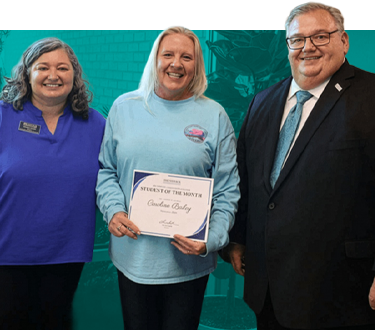
Caroline Bailey
We’re proud to recognize Caroline Bailey as BCC’s October Student of the Month. President Gene Smith surprised Caroline with the announcement during class, celebrating her remarkable dedication, leadership, and enthusiasm for learning.